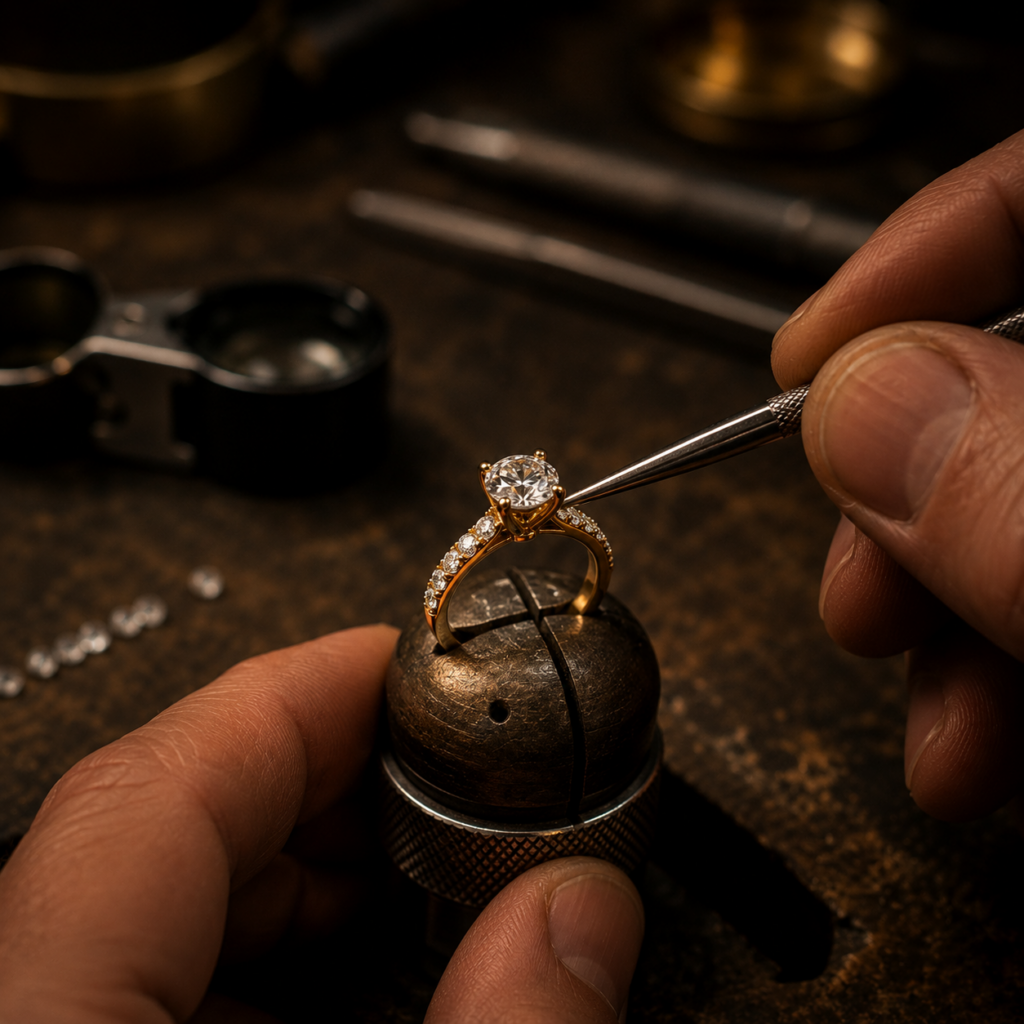
If you’ve ever searched “How much does jewelry repair cost?” you’ve probably noticed that prices vary significantly from one jeweler to another. That’s because every repair is unique. Two rings with the same visible damage may require completely different repair methods depending on the type of metal, gemstone setting, structural integrity, and amount of skilled labor involved.
Whether you’re repairing a broken gold chain, resizing a wedding band, replacing a missing diamond, restoring an antique family heirloom, or rebuilding worn prongs, understanding what influences jewelry repair pricing can help you make informed decisions before trusting someone with your jewelry.
Professional jewelry repair is almost always more affordable than replacing a cherished piece. In many cases, a timely repair not only restores the beauty of your jewelry but also prevents additional damage that could become much more expensive later.
According to Jewelers of America, routine inspections and professional maintenance help extend the lifespan of fine jewelry while reducing the risk of loose stones, worn prongs, broken chains, and other common issues that become more costly when left unaddressed.
This guide explains average jewelry repair costs across the United States, typical pricing throughout the Dallas–Fort Worth Metroplex, what factors influence repair estimates, and how to determine whether repairing your jewelry is the right investment.
Why Jewelry Repair Prices Vary
Unlike many products with fixed prices, jewelry repair is a skilled trade. Every repair requires a different combination of craftsmanship, specialized equipment, precious metals, gemstones, and labor.
Several factors influence repair costs, including:
- Type of repair
- Metal type
- Jewelry design
- Stone type
- Stone setting
- Size of the repair
- Labor required
- Replacement materials
- Age of the jewelry
- Previous repairs
- Turnaround time
Even two seemingly identical rings may receive different estimates after inspection because one may have hidden structural wear that isn’t immediately visible.
Professional jewelers evaluate every piece individually before recommending the safest repair method.
Average Jewelry Repair Costs Nationwide
Across the United States, jewelry repair pricing is influenced by local labor costs, precious metal prices, and the complexity of each repair. While no two repairs are exactly alike, the following estimates reflect common pricing reported by independent jewelry repair shops nationwide.
| Service | Typical U.S. Price |
|---|---|
| Ring Sizing | $75–$160 |
| Gold Chain Repair | $45–$150 |
| Clasp Replacement | $50–$165 |
| Prong Repair | $85–$225 |
| Stone Tightening | $25–$75 |
| Rhodium Plating | $75–$175 |
| Jewelry Cleaning & Inspection | $25–$75 |
| Bracelet Repair | $50–$200+ |
| Pendant Repair | $50–$200+ |
| Jewelry Restoration | $200–$1,000+ |
These ranges are intended as general guidelines. Repairs involving platinum, custom fabrication, antique jewelry, laser welding, or large diamonds often exceed these estimates due to the additional skill and labor required.
Typical Jewelry Repair Costs in Dallas–Fort Worth
Dallas–Fort Worth is home to one of the largest jewelry markets in Texas, with hundreds of independent jewelers, luxury retailers, and experienced bench jewelers serving customers throughout the Metroplex.
Because of this competitive market, many common jewelry repairs are priced similarly to—or slightly below—the national average. However, pricing still depends on the jeweler’s experience, equipment, and the complexity of the repair.
Typical DFW pricing often falls within these ranges:
| Service | Typical DFW Price |
|---|---|
| Ring Sizing | $50–$175+ |
| Gold Chain Repair | $30–$150+ |
| Clasp Replacement | $30–$100+ |
| Prong Repair | $35–$85 per prong |
| Stone Tightening | $20–$75 |
| Rhodium Plating | $75–$125 |
| Jewelry Cleaning & Polish | $25–$60 |
| Bracelet Repair | $40–$200+ |
| Pendant Repair | $40–$175+ |
| Jewelry Restoration | $150–$1,000+ |
Although these estimates provide a useful benchmark, every repair should be professionally evaluated before pricing is determined.
What Should You Expect to Pay?
Most jewelry repairs fall into one of three general categories.
Minor Repairs ($25–$75)
These repairs are generally quick and involve minimal labor.
Examples include:
- Professional jewelry cleaning
- Jewelry inspection
- Polishing
- Tightening loose stones
- Replacing jump rings
- Minor solder work
- Basic clasp adjustments
Standard Repairs ($75–$250)
These are the repairs most customers request.
Examples include:
- Ring sizing
- Gold chain repair
- Bracelet repair
- Prong rebuilding
- Rhodium plating
- Pendant repair
- Clasp replacement
- Stone replacement labor
These repairs require more technical skill but can usually restore jewelry to excellent condition.
Major Repairs ($250 and Above)
More extensive repairs often require several hours of skilled labor.
Examples include:
- Antique jewelry restoration
- Platinum repairs
- Rebuilding damaged settings
- Complete ring reshanking
- Multiple stone replacements
- Custom fabrication
- Structural reconstruction
- Extensive heirloom restoration
These projects often involve several repair procedures performed together rather than a single repair.
Ring Sizing Costs
Ring sizing remains one of the most common jewelry repair services.
Several factors influence pricing, including:
- Whether the ring is being made larger or smaller
- Gold, platinum, or sterling silver
- Ring width
- Number of gemstones
- Engraving
- Eternity bands
- Designer construction
Simple gold wedding bands are often less complicated than rings featuring multiple diamonds or intricate settings.
Certain rings cannot safely be resized using traditional methods and require specialized solutions.
Gold Chain Repair Costs
Broken gold chains are another common repair.
Pricing depends on:
- Chain style
- Chain thickness
- Metal type
- Location of the break
- Whether links require rebuilding
- Clasp replacement
- Jump ring replacement
Popular chain styles include:
- Cuban Link
- Franco
- Rope
- Figaro
- Cable
- Box
- Wheat
- Singapore
- Snake
- Curb
Some chain styles require significantly more labor because individual links must be reconstructed rather than simply soldered together.
Diamond and Gemstone Replacement Costs
Replacing a missing diamond involves much more than installing another stone.
The jeweler must evaluate:
- Stone size
- Shape
- Color
- Clarity
- Carat weight
- Matching existing stones
- Setting condition
- Prong wear
Before installing a replacement, the mounting should always be inspected to determine why the original stone was lost.
Repairing worn prongs first helps protect the replacement stone from future damage.
Prong Repair Costs
Prongs naturally wear down over years of everyday use.
Depending on their condition, repairs may include:
- Tightening
- Retipping
- Partial rebuilding
- Complete rebuilding
- Head replacement
Repairing worn prongs early is significantly less expensive than replacing a lost diamond.
The Gemological Institute of America (GIA) recommends periodic inspections to identify loose stones before they become lost.
Jewelry Restoration Costs
Jewelry restoration differs from standard repair because it often involves multiple procedures performed together.
Restoration projects commonly include:
- Ring sizing
- Prong rebuilding
- Stone replacement
- Rhodium plating
- Deep cleaning
- Polishing
- Structural reinforcement
- Metal restoration
Because each project is unique, restoration pricing varies considerably depending on the amount of labor required.
Many heirloom pieces require specialized restoration techniques that preserve the original craftsmanship while improving long-term durability.
Why Metal Type Affects Repair Pricing
Different precious metals require different repair methods.
Gold is one of the easiest precious metals to repair and is available in several purities, including 10K, 14K, 18K, and 22K.
Platinum is denser than gold and generally requires more specialized equipment and additional labor.
Sterling silver is relatively straightforward to repair but often requires polishing and finishing after soldering to restore its appearance.
Understanding how different metals behave during repair helps explain why pricing varies between otherwise similar pieces of jewelry.